What the Evidence Actually Shows About Biotin for Hair, Skin, and Nails
Quick Answer: Biotin supplements only reliably improve hair, skin, and nail quality in people who have an actual biotin deficiency, which is rare in anyone eating a varied diet. For everyone else, controlled research shows little to no measurable benefit beyond what a normal diet already provides.
Walk down any supplement aisle and biotin is the common thread across dozens of hair, skin, and nail products, usually in doses hundreds of times higher than what your body actually needs. The clinical picture behind those claims is a lot narrower than the label art suggests.

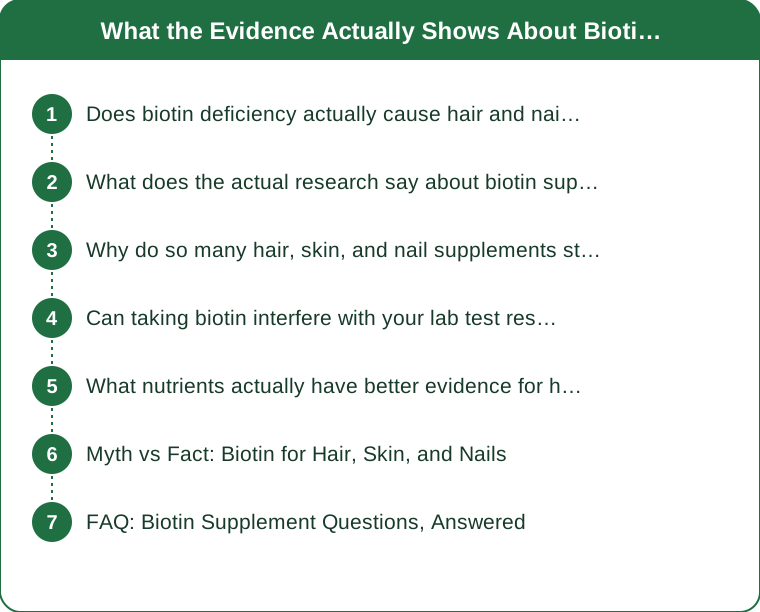
Does biotin deficiency actually cause hair and nail problems?
Yes, but true biotin deficiency is genuinely uncommon in people eating a reasonably varied diet. Documented causes include long-term consumption of large amounts of raw egg whites (raw egg white contains avidin, a protein that binds biotin and blocks absorption), certain long-term anticonvulsant medications, prolonged intravenous feeding without biotin supplementation, and a rare inherited condition called biotinidase deficiency.
When deficiency does happen, the symptoms are real: thinning hair, brittle nails, and a scaly rash around the eyes, nose, and mouth. The problem is that these same symptoms show up in dozens of other common conditions — thyroid issues, iron deficiency, eczema, and simple aging — which is exactly why so many people assume biotin is the fix when something else is actually going on.
If you suspect an actual deficiency rather than just wanting thicker hair, a doctor can check biotin status through blood or urine testing rather than guessing from symptoms alone. Self-diagnosing based on hair shedding alone is where most of the confusion starts.
What does the actual research say about biotin supplements for healthy people?
The studies most often cited to support biotin supplements were conducted in people who already had a diagnosed deficiency — and in those cases, supplementation genuinely did improve hair and nail symptoms, because it was correcting a real shortfall. That’s a very different situation from a healthy person with a normal diet taking a biotin gummy hoping for thicker hair.
In healthy, non-deficient populations, placebo-controlled trials have generally failed to show a measurable difference in hair growth, hair thickness, or nail strength between biotin and placebo groups. Dermatology professional bodies have echoed this — several clinical reviews note that routine biotin supplementation for hair loss in people without deficiency is not supported by strong evidence, even though it remains one of the most commonly recommended over-the-counter options.
This doesn’t mean biotin supplements do nothing at all for every single person — individual responses vary and placebo effects on hair concerns are well documented — but it does mean the evidence base is much thinner than the marketing implies, and shouldn’t be the first thing you reach for if your actual goal is visibly stronger hair or nails.
Why do so many hair, skin, and nail supplements still lead with biotin?
Part of it is genuinely cheap manufacturing economics — biotin is inexpensive to produce in high doses, which makes it an easy ingredient to headline on a bottle. Part of it is a halo effect: biotin is a real, essential B-vitamin involved in keratin production, so the underlying science sounds plausible even when the applied dose for a non-deficient person doesn’t move the needle.
Anecdotal reporting also plays a large role. Hair and nail growth cycles are slow — nails take months to fully regrow, hair growth cycles run in multi-month phases — so any supplement taken consistently over a few months will coincide with some natural, unrelated improvement or seasonal change, and it’s easy to credit the pill for something that would have happened anyway.
Marketing regulations for supplements are also looser than for medications, meaning a product can say ‘supports healthy hair’ based on biotin’s known biological role, without needing a clinical trial proving the finished product actually changes visible hair or nail outcomes in the people buying it.

Can taking biotin interfere with your lab test results?
This is one of the more overlooked, genuinely documented risks, and it’s a bigger deal than most people realize. Biotin is used in many common lab assays — including thyroid function tests and cardiac troponin tests used to diagnose heart attacks — because those tests rely on a biotin-streptavidin binding mechanism. High-dose biotin supplements can throw off these results, producing falsely high or falsely low readings depending on the specific test.
The FDA has issued a formal safety communication about this exact issue after cases where biotin supplementation led to inaccurate troponin results in the emergency room, delaying appropriate diagnosis of an actual heart attack in at least one reported case. This isn’t a rare theoretical risk — it’s specific and well-documented enough to warrant its own regulatory alert.
The practical takeaway: always tell your doctor about any biotin supplement before bloodwork, and consider stopping it for a few days beforehand if a test is scheduled, since even doses found in over-the-counter hair, skin, and nail gummies can be high enough to interfere.
What nutrients actually have better evidence for hair, skin, or nail changes?
If you’re dealing with genuine hair thinning, brittle nails, or dull skin, other nutrients have a stronger evidence base — again, mainly when correcting an actual deficiency rather than as a blanket boost. Iron (specifically ferritin, the stored form) has one of the better-documented links to hair shedding in women, particularly those with heavy menstrual cycles; low ferritin is a genuinely common, testable cause of hair thinning that’s frequently missed.
Total daily protein intake matters more than any single supplement, since hair and nails are largely built from protein (keratin), and chronically low intake shows up in both within months. Zinc deficiency has documented links to hair and skin issues, though again mainly relevant if you’re actually low. Omega-3 fatty acids have reasonable evidence for skin barrier and hydration support.
The common thread across all of these: testing for an actual deficiency before supplementing is far more useful than guessing, since supplementing a nutrient you’re not short on rarely produces a visible change — the improvement mainly comes from correcting a real gap.
Myth vs Fact: Biotin for Hair, Skin, and Nails
Myth: Taking more biotin than the daily requirement produces faster hair growth. Fact: Once biotin needs are met, extra amounts aren’t shown to accelerate growth beyond normal — the body doesn’t store or use excess in a way that speeds up keratin production further.
Myth: If a hair supplement contains biotin, it must be effective. Fact: Biotin’s presence reflects marketing convention more than proven efficacy in non-deficient people — several combination supplements’ actual results come from other ingredients (or from consistent use of the product coinciding with the hair’s natural growth cycle).
Myth: Biotin supplements are risk-free since it’s a water-soluble vitamin. Fact: While true toxicity is rare, high-dose biotin has a documented, specific risk of interfering with certain medical lab tests, which is a real and avoidable safety issue.
FAQ: Biotin Supplement Questions, Answered
How much biotin is actually in a typical hair, skin, and nail gummy?
Many over-the-counter formulas contain 5,000-10,000 micrograms per serving, compared to a normal adult daily requirement of around 30 micrograms — often 150-300 times the basic need, which is part of why lab test interference is a real concern.
Should I stop biotin before a blood test even if I feel fine?
Yes — the interference issue isn’t related to how you feel, it’s a chemistry issue with the test itself, so it’s worth mentioning any biotin supplement to your doctor and following their guidance on stopping it beforehand, typically for a few days.
If biotin isn’t the answer, what’s the first practical step for thinning hair?
A doctor visit that includes a ferritin (iron) level and thyroid panel is usually a more productive first step than supplement shopping, since both are common, testable, and treatable causes that biotin alone won’t address.
TL;DR:
- Biotin supplements mainly help people with an actual, diagnosed deficiency — which is uncommon
- Placebo-controlled research in non-deficient people generally shows little measurable benefit
- High-dose biotin can cause falsely inaccurate thyroid and cardiac lab test results
- Iron, protein intake, zinc, and omega-3s have stronger evidence when an actual gap exists
This is general information, not medical advice — talk to a doctor before starting any supplement, especially if you have bloodwork scheduled.
Keep Reading
This article is for general informational purposes only and is not medical advice. Always consult a qualified health professional for guidance specific to you.