The Complete Guide to Under-Eye Circles: What Nutrition Can and Cannot Change
Quick Answer: Under-eye circles come in four broad types - pigmented, vascular, structural, and fluid-related - and only two of them respond meaningfully to nutrition. Vascular circles often improve with iron status, hydration, sleep, and lower sodium. Fluid-related puffiness responds to salt, alcohol, and sleep position. Pigmented and structural circles are genetic or anatomical and will not change with diet. Identify your type first, because that determines whether any of this is worth your time.
You have tried the cucumber, the caffeine cream, and eight hours of sleep, and one of them worked slightly.
That is not a failure of effort. It is a sign that most under-eye advice is written without asking which kind of circle you actually have.

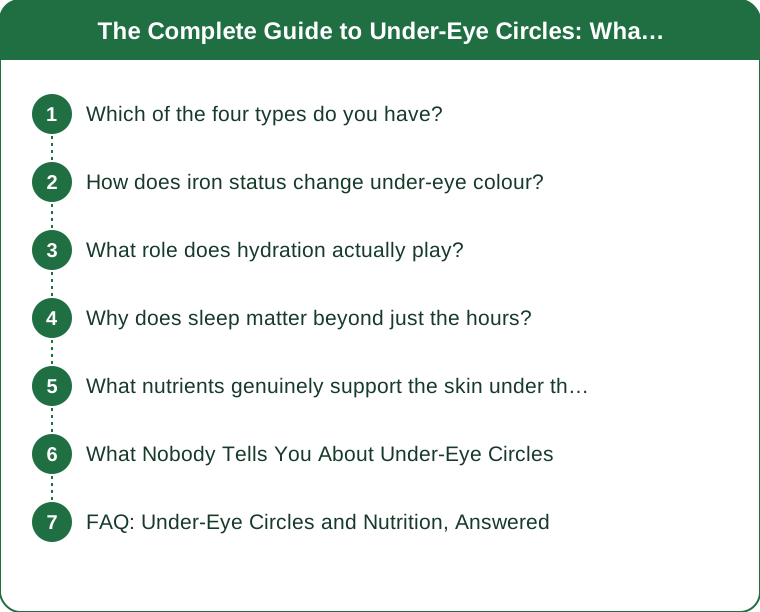
Which of the four types do you have?
There are four mechanisms, and they look different in specific ways. Working out which one you have takes about two minutes in front of a mirror and it changes everything that follows.
Vascular circles are blue, purple, or reddish rather than brown. The skin under the eye is the thinnest on the body - roughly half a millimetre - and the vessels beneath it show through. If the colour looks like it is under the skin rather than in it, this is your type.
Pigmented circles are brown or grey-brown and are most common in people with medium to deep skin tones. Gently stretch the skin sideways: if the colour stretches with the skin and stays visible, the pigment is in the skin itself.
Structural shadows are not colour at all. Tilt your face upward toward a light source - if the darkness largely disappears, you were looking at a shadow cast by the tear trough or by volume loss beneath the eye, not a pigment or a vessel.
Fluid-related darkness comes with visible puffiness that is worst on waking and improves over two to three hours as you stay upright. It also varies enormously day to day, which the other three do not.
Most people have a combination, and the useful question is which one dominates. Nutrition has a genuine effect on vascular and fluid types, a marginal effect on pigmented ones, and no effect at all on structural shadows - which is exactly why generic advice produces such inconsistent results and why so many people conclude nothing works.
A practical test: photograph the same area in the same light on three mornings, one of them after a poor night and high-salt evening. If the difference between photos is dramatic, you have a fluid or vascular component worth working on. If all three are identical, you are looking at pigment or structure and the honest answer is that food will not be the lever.
How does iron status change under-eye colour?
Iron deficiency is the single most commonly missed nutritional contributor to vascular circles, and it is disproportionately common in menstruating women, endurance athletes, and people eating little or no red meat.
The mechanism is straightforward. Lower haemoglobin means blood that carries less oxygen, and deoxygenated blood is darker and bluer. Under skin that thin, the colour difference is visible.
The symptom pattern matters more than the circles alone. Iron deficiency that is contributing to under-eye colour is usually accompanied by fatigue that sleep does not fix, cold hands and feet, breathlessness on stairs, brittle nails, or hair shedding.
Ferritin is the test worth asking for, not just haemoglobin. You can have normal haemoglobin and depleted iron stores, and the stores are what run out first. Many people are told their bloods are normal when their ferritin sits at the very bottom of the reference range.
Timeline expectations are important here. If low iron is a genuine contributor, correcting it takes three to six months to show in the under-eye area, because you are waiting on red blood cell turnover and on stores rebuilding, not on a surface change.
On absorption, the practical points are these: pair iron-rich foods with vitamin C, keep tea and coffee at least an hour away from iron-rich meals since both markedly reduce absorption, and know that heme iron from meat and fish absorbs several times more efficiently than the plant forms.
Do not supplement iron without testing. Iron overload is genuinely harmful, supplements cause constipation and stomach upset at rates high enough to matter, and taking them blind means you never learn whether iron was your issue at all. Get the test, then decide - and treat this as general information rather than medical advice.
What role does hydration actually play?
Hydration affects under-eye appearance through two separate routes, and people usually only know about one of them.
The first is skin translucency. Dehydrated skin sits closer to the vessels beneath it and reflects light differently, which makes vascular colour more visible. This is a same-day effect and it is why the area often looks worse the morning after a long flight or a heavy night.
The second is fluid distribution, which is more counterintuitive. Chronic under-hydration combined with high sodium intake encourages the body to retain fluid, and the loose tissue under the eye is one of the first places it shows.
Drinking more water while sodium stays high does not fix this, which is why the advice to just drink more water so often disappoints. The ratio matters more than the volume.
A workable baseline is 30 to 35ml per kilogram of bodyweight daily, adjusted up for training and heat. For most adult women that lands somewhere between two and two and a half litres.
Front-load it. Most of your intake before mid-afternoon means better hydration status through the day and less overnight fluid shift, which is the specific mechanism behind morning puffiness.
Sodium is the lever most people have not pulled. Intakes above roughly 2,300mg a day - which most packaged food easily delivers without anything tasting salty - drive measurable morning puffiness in susceptible people. A two-week reduction is the cleanest self-test available, because the effect appears within days rather than months and reverses just as fast, which makes cause and effect unusually easy to read.

Why does sleep matter beyond just the hours?
Sleep affects under-eye appearance through vasodilation, fluid position, and cortisol, and each of those responds to something slightly different.
Short sleep dilates the blood vessels under the eye, which is the immediate reason a bad night is visible in the mirror the next morning. This part is genuinely about duration, and it reverses within a night or two of adequate sleep.
Sleep position governs overnight fluid pooling. Lying flat allows fluid to settle in the periorbital tissue for seven or eight hours; sleeping with the head elevated by roughly 10 to 15 degrees measurably reduces morning puffiness in people whose circles have a fluid component.
An extra pillow usually creates a neck angle rather than an elevation. Raising the head of the bed itself, or using a wedge, is what actually produces the effect.
Chronic short sleep raises cortisol, and elevated cortisol contributes to fluid retention and to inflammatory changes in the skin over weeks. This part is not fixed by one good night - it needs a run of consistent sleep to shift.
Consistency beats duration for the cortisol pathway. Seven hours at the same time every night produces better outcomes than a pattern of five hours on weeknights and ten at weekends, even though the weekly total is similar.
Alcohol deserves a specific mention because it hits all three routes at once - it dilates vessels, drives dehydration and subsequent fluid retention, and fragments sleep architecture even when total hours look normal. For most people, the single most visible under-eye change available in a week is three or four alcohol-free nights in a row.
Expect the sleep-related component to improve within two weeks, which makes it the fastest-responding item on this entire list.
What nutrients genuinely support the skin under the eye?
Vitamin C does two relevant things - it is required for collagen synthesis, and it strengthens capillary walls. Thin, fragile capillaries leak slightly, and that contributes to both colour and pigment deposition over time.
Aim for food sources spread across the day rather than one large dose, since absorption is saturable. Peppers, citrus, kiwi, berries, and broccoli all comfortably clear the daily requirement.
Vitamin K is involved in blood clotting and capillary integrity, and it is the nutrient behind most under-eye creams that claim to work on dark circles. Dietary sources - leafy greens, broccoli, Brussels sprouts - matter more than the topical versions for most people.
Vitamin B12 and folate deficiencies produce their own form of anaemia, with the same darker-blood mechanism as iron. B12 deficiency specifically is worth testing in anyone eating little or no animal food, and it can also cause hyperpigmentation in some people.
Protein is the unglamorous requirement underneath all of this. Collagen production needs adequate amino acids, and skin quality in general tracks protein intake more closely than it tracks any single micronutrient. Around 1.2 to 1.6g per kilogram of bodyweight daily supports skin and hair alongside training needs.
Antioxidant intake and general polyphenol-rich eating support the microvasculature over months rather than weeks. This is a slow, real, unexciting effect - the kind that shows up in a year of consistent eating and not in a photo comparison after a fortnight.
Collagen supplements have modest evidence for skin elasticity and hydration in the studies that exist, though most are industry-funded and effects are small. If you want to try one, 2.5 to 10g daily for three months is the tested range - and it is a reasonable optional extra rather than a foundation.
What none of these will do is change pigment that is genetically determined or fill a tear trough that is anatomically deep. That limit is worth accepting early rather than after two years of supplements.
What Nobody Tells You About Under-Eye Circles
Sun exposure is a major driver of the pigmented type and almost nobody applies sunscreen there. The under-eye area is routinely missed in both application and reapplication, and UV drives melanin production in the thinnest skin on the body. If your circles are brown, this is likely doing more damage than anything on your plate.
Rubbing your eyes causes measurable pigmentation over time. Chronic allergic rhinitis, hay fever, and dust sensitivity produce what clinicians sometimes call allergic shiners - a combination of venous congestion and rubbing-induced pigment. Treating the allergy does more for those circles than any nutrition change will.
They get more visible with age regardless of what you do, because skin thins and the fat pad under the eye loses volume. Someone with mild vascular circles at 25 will usually have more visible ones at 45, and that is anatomy rather than a failure of routine.
Genetics predict this better than habits do. If both parents have prominent under-eye circles that persisted through their twenties and thirties, yours are likely structural or pigmented, and the honest expectation is management rather than resolution.
Screen time is not a documented cause of dark circles, though eye strain causes the squinting and rubbing that contribute to the pigmented type. The mechanism people assume is wrong, but the correlation is real for an indirect reason.
Thyroid and kidney conditions can both present with periorbital changes, which is one genuine reason not to dismiss a sudden, persistent change as cosmetic. New puffiness that does not resolve, especially with fatigue or weight changes, deserves a proper assessment.
And the most useful thing nobody says out loud: if you have identified your type as structural or genetically pigmented, the healthiest possible outcome is to stop spending money on it. That is not defeat - it is the specific knowledge that saves people years of trying products designed for a mechanism they do not have.
FAQ: Under-Eye Circles and Nutrition, Answered
Can dark circles be a sign of a health problem?
Sometimes. Iron deficiency, B12 deficiency, thyroid conditions, kidney issues, and chronic allergies can all contribute. A sudden or steadily worsening change - particularly with fatigue, weight change, or puffiness that does not resolve - is worth a medical assessment rather than a skincare purchase.
How long before nutrition changes show?
It depends entirely on the mechanism. Sleep and sodium changes show within one to two weeks. Hydration shows in days. Iron correction takes three to six months. Collagen and antioxidant effects take months. Pigmented and structural circles do not respond at any timeline.
Does drinking more water really help?
Only if you are genuinely under-hydrated, and only alongside reasonable sodium intake. Drinking three litres a day while eating 4,000mg of sodium will not reduce puffiness - the ratio is what matters, not the volume.
Should I take an iron supplement for dark circles?
Not without a ferritin test. Iron overload is harmful, supplements commonly cause digestive side effects, and supplementing blind means you never find out whether iron was your issue. Test first.
Do cold spoons and caffeine creams work?
For the fluid-related type, yes, temporarily - cold causes vasoconstriction and reduces puffiness for a few hours. They do nothing for pigment or structure.
Is sleeping propped up actually worth it?
If your circles are worst on waking and fade through the morning, yes. Raise the head of the bed 10 to 15 degrees rather than adding a pillow, which mostly bends the neck.
What is the single highest-impact change?
For most people it is three or four consecutive alcohol-free nights with consistent sleep timing and lower sodium. If that produces no visible change at all, your circles are likely pigmented or structural, and that is genuinely useful information.
TL;DR:
- Identify your type first - vascular, pigmented, structural, or fluid-related - because only two of the four respond to nutrition at all.
- Iron deficiency is the most commonly missed contributor to vascular circles; ask for ferritin, not just haemoglobin, and expect three to six months.
- Sodium reduction and hydration ratio matter far more than water volume for the fluid type.
- Sleep consistency, head elevation of 10 to 15 degrees, and a few alcohol-free nights produce the fastest visible change.
- Sunscreen under the eye and treating allergies do more for pigmented circles than any food will.
If your circles are structural or genetically pigmented, the most valuable outcome is knowing to stop spending on them. This is general information, not medical advice.
Keep Reading
This article is for general informational purposes only and is not medical advice. Always consult a qualified health professional for guidance specific to you.