The Complete Guide to How Skin Nutrition Needs Change by Decade
Quick Answer: The fundamentals — adequate protein, sufficient vitamin C, omega-3 fats, and sun protection — matter at every age. What changes is emphasis: your twenties are about establishing the baseline and protecting against damage, thirties about protein and antioxidant support as collagen synthesis slows, forties and fifties about the accelerated collagen loss around menopause plus barrier and hydration support, and sixties onward about protein adequacy and absorption, which both become harder.
The advice doesn’t change much between decades because the biology doesn’t change all at once. But the emphasis genuinely shifts, and the shifts are predictable enough to plan around.
Here’s what actually differs, and — just as usefully — what doesn’t.

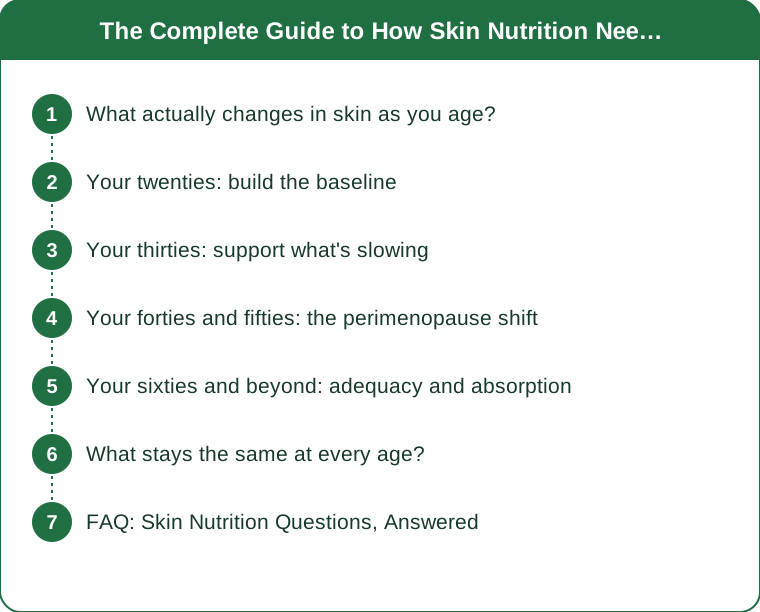
What actually changes in skin as you age?
Three processes, running at different rates, and understanding them explains every recommendation that follows.
Collagen production declines steadily. Collagen is the structural protein that gives skin firmness, and its production slows gradually from the mid-twenties onward. The commonly cited figure is roughly 1% per year — a rough approximation rather than a precise rate, but directionally right. Existing collagen also becomes more cross-linked and less flexible over time.
Barrier function and hydration decline. The skin’s outer layer holds moisture in, and both its lipid content and natural moisturizing factors decrease with age. This is why dryness becomes a bigger complaint in later decades even for people who never had dry skin.
Cell turnover slows. The rate at which new skin cells reach the surface decreases, which affects texture, radiance, and how quickly skin recovers from irritation.
Layered on top is the largest single factor, which isn’t chronological at all: cumulative UV exposure. Photoaging accounts for a substantial majority of visible skin aging on exposed areas — an estimate frequently cited is around 80%. This is why the single most valuable intervention at every age is sun protection, and why no nutritional strategy can compensate for skipping it.
The honest framing that should sit under everything below: nutrition supports skin’s ability to maintain and repair itself. It doesn’t reverse structural aging, and any recommendation implying otherwise is overselling. What it can do is meaningful — but it operates within limits.
Your twenties: build the baseline
Collagen production is still near its peak and skin recovers quickly. The emphasis here is on habits and protection rather than repair.
What matters most:
Sun protection, above everything else. The damage accumulating now shows up in your forties. This is by far the highest-return thing available in this decade, and it’s not a nutrition item — but any honest guide has to lead with it.
Adequate protein. Skin is largely protein, and it’s continually rebuilt. Chronically low protein intake shows in skin, hair, and nails. A reasonable general target for active adults is around 1.2-1.6g per kg of body weight — a range that comfortably covers skin needs alongside everything else.
Vitamin C, consistently. It’s an essential cofactor for collagen synthesis — the process genuinely cannot proceed properly without it. Deficiency is rare in developed countries, but intake at the low end is common in people who eat few fruits and vegetables. Citrus, peppers, kiwi, broccoli, and berries all deliver.
Omega-3 fats. They contribute to the skin’s lipid barrier and have anti-inflammatory effects. Oily fish twice a week, or a supplement if you don’t eat fish.
Watch for the specific twenties pattern: irregular eating, low-calorie phases, and heavy alcohol. Skin is among the first tissues to show a chronic energy deficit, because the body prioritizes organs over cosmetic tissue. Under-eating shows in skin before it shows almost anywhere else.
What’s not worth your money yet: collagen supplements. With production still near peak and no shortage of raw materials, this is the decade where they’re least likely to do anything.
Your thirties: support what’s slowing
Collagen production has been declining for a few years and cumulative sun exposure starts becoming visible. Repair capacity is still strong.
Where the emphasis shifts:
Protein becomes more deliberate. Not more than the twenties in absolute terms, but distribution matters more — spreading intake across meals rather than concentrating it at dinner supports protein synthesis better than a single large serving.
Antioxidant variety, not antioxidant supplements. The evidence supports a varied diet rich in plant foods far more strongly than it supports isolated high-dose antioxidant supplements, some of which perform worse than the whole foods they came from. Practical version: aim for genuine color variety across your week — dark leafy greens, orange and red vegetables, berries, tomatoes.
Vitamin A from food. Retinoids are among the best-supported topical ingredients for skin. Dietary vitamin A — from liver, eggs, dairy, and as beta-carotene in orange and dark green vegetables — supports normal skin cell turnover. Note that dietary intake isn’t a substitute for topical retinoids; they work through different routes.
Zinc gets more relevant. It’s involved in wound healing and skin repair. Low intake is more common than people expect, particularly in those eating little meat or seafood. Oysters, beef, pumpkin seeds, and legumes are the main sources.
The thirties reality: this is often the decade of least sleep and most stress, and both show in skin quickly. Chronic stress and short sleep affect barrier recovery measurably. Nothing on your plate compensates for five hours a night — worth being honest about, since this decade is where people start buying products to solve a sleep problem.

Your forties and fifties: the perimenopause shift
This is where the largest change happens, and it’s worth being specific because it’s frequently glossed over.
Estrogen influences skin collagen content, thickness, and hydration. As estrogen declines through perimenopause and menopause, collagen loss accelerates markedly — research commonly cites a substantial proportion of skin collagen lost in the first five years after menopause, with a slower ongoing decline afterward. Skin thickness, elasticity, and moisture retention all shift over a relatively compressed period.
This is why many people describe skin changing faster in this window than in the previous twenty years combined. It’s not imagination, and it’s not something you did.
Where nutrition genuinely helps:
Protein becomes the priority nutrient. Protein needs rise with age as muscle protein synthesis becomes less efficient, and adequate protein supports skin structure alongside everything else. Many people in this decade are eating meaningfully less protein than they need — around 1.2-1.6g per kg is a reasonable target, spread across meals.
Collagen peptides become worth considering. This is the decade where the evidence is most interesting. Several randomized trials have found modest improvements in skin elasticity and hydration with hydrolyzed collagen peptides, typically 2.5-10g daily over 8-12 weeks. The effects are real but modest, the research base is still developing, and industry funding is common in this area. A reasonable position: worth trying if you’re curious and the cost doesn’t bother you, with realistic expectations rather than transformation.
Barrier support through fats. With declining barrier function, dietary fat quality matters more. Omega-3s, olive oil, nuts, and avocado all contribute.
Hydration and sodium. Fluid needs don’t change dramatically, but thirst sensation begins to decline — which means intake often falls without any conscious decision.
Bone and muscle deserve mention here, because they change on the same timeline and matter more than skin does. Calcium, vitamin D, and resistance training are the priorities of this decade, and the skin benefits are a bonus rather than the reason.
Your sixties and beyond: adequacy and absorption
The emphasis moves from optimization to making sure the basics are actually landing — because two things make that harder.
Protein needs stay high while intake typically falls. Appetite declines, cooking for one or two is less motivating, and dental issues can limit food choices. Meanwhile the efficiency of muscle protein synthesis decreases, so requirements per meal actually go up. Many researchers suggest older adults benefit from higher protein intake than younger adults, and roughly 25-30g per meal is often cited as the threshold that meaningfully stimulates synthesis.
Absorption changes for specific nutrients. Stomach acid production declines with age, which affects absorption of vitamin B12, iron, and to some degree calcium. B12 deficiency is genuinely common in older adults and shows up in skin, energy, and cognition. It’s worth testing rather than guessing.
Vitamin D synthesis in skin declines substantially with age — older skin produces considerably less vitamin D from the same sun exposure. Combined with typically less time outdoors, supplementation is commonly recommended in this age group.
Hydration needs active attention. Thirst sensation declines noticeably, and some medications increase fluid loss. Scheduled drinking rather than waiting for thirst is genuinely useful here.
What to prioritize, in order:
- Enough total food — under-eating is the most common problem in this decade
- Protein at every meal, roughly 25-30g
- Vitamin D, usually supplemented
- B12 status, tested rather than assumed
- Fluid on a schedule
Skin appearance in this decade tracks overall nutritional adequacy closely. The specifics matter less than whether the basics are consistently met.
What stays the same at every age?
A short list that does most of the work, and it’s worth stating plainly because it doesn’t change at all.
Sun protection. The highest-return intervention in every decade without exception. No dietary strategy comes close.
Enough total food and enough protein. Chronic under-eating shows in skin at every age, and skin is one of the first tissues the body deprioritizes.
A varied plant-rich diet. The evidence consistently favors dietary patterns over individual nutrients. Variety across colors and food groups outperforms any single supplement at any age.
Sleep. Barrier recovery, inflammation, and repair processes all depend on it. Short sleep shows in skin within days.
Not smoking, and moderate alcohol. Both affect skin structure directly and substantially — smoking is second only to sun exposure among lifestyle factors in visible skin aging.
Myth vs Fact: Myth — drinking more water gives you glowing skin. Fact — dehydration does make skin look worse, so meeting your needs matters. But drinking beyond adequate hydration doesn’t produce further benefit; the excess is simply excreted. The visible improvement people report after increasing water intake usually comes from correcting an actual deficit, not from the extra.
Myth: Collagen supplements rebuild your skin’s collagen directly. Fact — ingested collagen is broken into amino acids and peptides like any protein. The proposed mechanism is that certain peptides signal fibroblast activity, and trial results are modestly positive. It’s plausible and partially supported, not the direct restocking the marketing implies.
FAQ: Skin Nutrition Questions, Answered
When should I start taking collagen supplements?
There’s no established starting age. The evidence is most interesting for people in their forties and beyond, where collagen decline is more pronounced. If you’re in your twenties with a good diet, it’s the least likely time to notice anything. Expect modest effects at any age.
Does sugar really age your skin?
There’s a real mechanism — glycation, where sugars bind to proteins including collagen and make them stiffer. It’s well documented biochemically. Whether normal dietary sugar intake produces meaningful visible differences is less clearly established. Moderating added sugar is reasonable for many reasons; treating it as the main driver of skin aging overstates it relative to sun exposure.
How long before dietary changes show in my skin?
Skin cell turnover takes roughly a month in younger adults and longer with age, so give any change at least 8-12 weeks before judging. Changes in hydration and inflammation can show faster; structural changes take considerably longer.
Should I take a supplement or just eat better?
Food first, for nearly everything. The clear exceptions are vitamin D in most northern climates, B12 for older adults and anyone eating little animal food, and omega-3s if you don’t eat fish. Beyond those, a varied diet outperforms supplementation for skin.
This is general information, not medical advice. Talk to a healthcare professional before starting supplements, particularly if you take medication or have a health condition.
TL;DR:
- Twenties: establish the baseline — sun protection, adequate protein, vitamin C, omega-3s. Skip collagen supplements.
- Thirties: distribute protein across meals, prioritize dietary variety over antioxidant supplements, and be honest about sleep.
- Forties-fifties: collagen loss accelerates around menopause. Protein becomes the priority nutrient; collagen peptides are worth a try with modest expectations.
- Sixties onward: focus on adequacy and absorption — 25-30g protein per meal, vitamin D, B12 tested, fluid on a schedule.
- Every decade: sun protection, enough food, varied plants, sleep. These do most of the work.
If you’re going to change one thing this month, make it protein distribution — spread across three meals rather than concentrated at dinner. It’s the recommendation that holds in every decade, and it’s the one most people are quietly missing.
Keep Reading
This article is for general informational purposes only and is not medical advice. Always consult a qualified health professional for guidance specific to you.