The Complete Guide to Eating for Genuinely Glowing Skin — What the Evidence Actually Supports
Quick Answer: Omega-3 fatty acids, vitamin C, zinc, and adequate hydration have the strongest evidence behind their connection to skin barrier function and appearance, while many trendy “glow foods” have thinner research support — building a diet around these core nutrients, consistently over months rather than days, is what actually shows up in skin appearance.
The idea that a single meal or juice cleanse could visibly change skin overnight is more marketing than physiology — but there’s real, specific nutrition science behind which foods matter over the longer term.

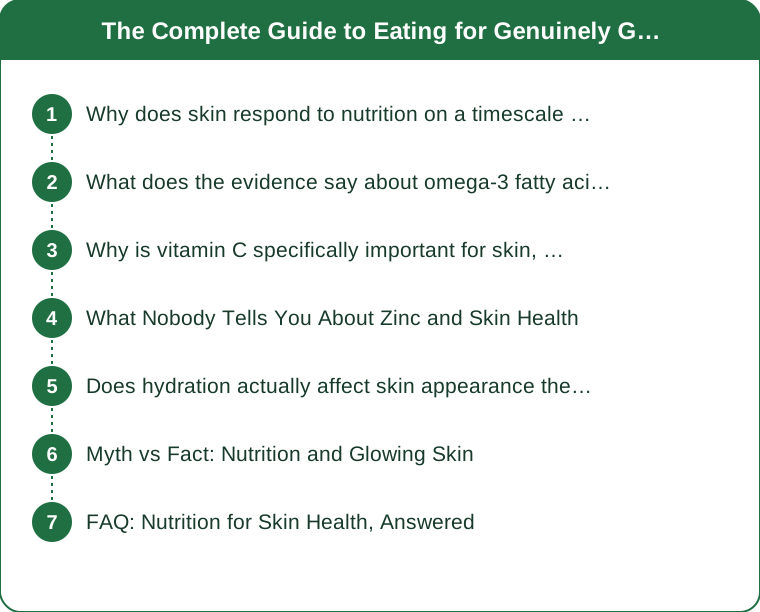
Why does skin respond to nutrition on a timescale of months rather than days?
Skin cells turn over on a roughly 28-day cycle in younger adults (slower with age), meaning the visible surface layer today reflects nutritional status from weeks ago, not this morning. This is the core reason consistent, sustained dietary patterns show up in skin appearance far more reliably than short-term dietary changes.
What does the evidence say about omega-3 fatty acids specifically?
Omega-3s, found in fatty fish, walnuts, and flaxseed, support the skin’s lipid barrier function, which affects moisture retention and can influence how inflamed or reactive skin appears. Multiple studies link adequate omega-3 intake to improved skin barrier measures, making it one of the better-supported “glow” nutrients.
Why is vitamin C specifically important for skin, beyond general antioxidant claims?
Vitamin C is a required cofactor for collagen synthesis — the body cannot produce collagen properly without it, which is a specific, well-established mechanism rather than a general antioxidant claim. Citrus, bell peppers, and berries are well-known dietary sources with strong evidence behind this particular pathway.

What Nobody Tells You About Zinc and Skin Health
Zinc deficiency is specifically linked in research to impaired wound healing and worsened inflammatory skin conditions, yet zinc gets far less attention than more marketed ingredients — pumpkin seeds, legumes, and lean meats are solid dietary sources, and even mild, common deficiency can measurably affect skin’s ability to repair itself.
Does hydration actually affect skin appearance the way it’s often claimed to?
The research here is more nuanced than popular claims suggest — well-hydrated skin does show improved elasticity in studies, but drinking beyond adequate hydration doesn’t appear to add extra benefit past a certain point, meaning the claim is true up to normal adequate intake, not indefinitely scalable.
Myth vs Fact: Nutrition and Glowing Skin
Myth: A single “detox” day noticeably improves skin. Fact: Skin cell turnover operates on a multi-week cycle — visible change requires sustained dietary patterns, not single-day interventions.
Myth: All antioxidant-rich foods have equal, interchangeable skin benefits. Fact: Specific nutrients (vitamin C for collagen, zinc for repair, omega-3s for barrier function) have distinct, non-interchangeable mechanisms.
FAQ: Nutrition for Skin Health, Answered
How long before dietary changes show up in visible skin appearance?
Given the roughly 28-day cell turnover cycle, most people report noticing changes after 6-8 weeks of consistent dietary adjustment, not days.
Do skin supplements work as well as getting these nutrients from food?
Whole foods generally provide better absorption and additional supporting nutrients than isolated supplements, though supplements can help address a specific, confirmed deficiency.
Does sugar intake really affect skin the way it’s often claimed?
There’s reasonable evidence linking high sugar intake to increased inflammation and accelerated collagen breakdown (glycation), making moderate sugar intake a genuinely supported part of a skin-focused diet.
TL;DR:
- Skin reflects nutrition from weeks ago, not today, due to its ~28-day cell turnover cycle
- Omega-3s support the skin’s lipid barrier and moisture retention with solid evidence behind them
- Vitamin C is a required cofactor for collagen production, not just a general antioxidant
- Zinc deficiency measurably impairs skin repair and is worth more attention than it gets
- Hydration matters up to adequate intake, but doesn’t scale indefinitely beyond that
Glowing skin isn’t about a perfect single day of eating — it’s the compounding effect of a handful of well-supported nutrients eaten consistently over weeks.
Keep Reading
This article is for general informational purposes only and is not medical advice. Always consult a qualified health professional for guidance specific to you.