The Complete Guide to Protein for Hair, Skin and Nails
Quick Answer: Hair, nails and the structural layer of skin are made almost entirely of protein, and the body deprioritizes all three when protein intake is insufficient. Most people need roughly 0.8 to 1.2 grams per kilogram of body weight daily, and active people more — commonly 1.4 to 2.0 g/kg. Deficiency shows up in hair and nails months after it starts, and improvement takes just as long to become visible.
Protein is one of the few nutrition levers with a genuinely direct structural relationship to how hair, skin and nails turn out.

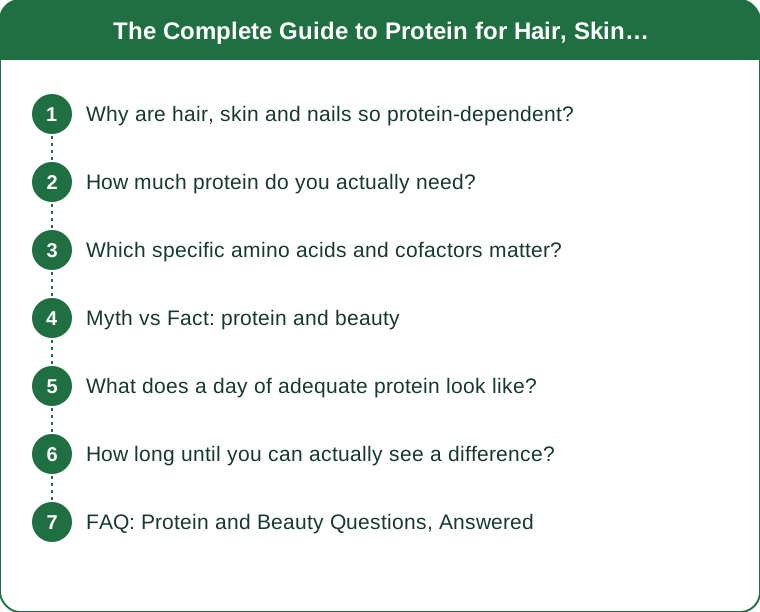
Why are hair, skin and nails so protein-dependent?
Because they are structurally made of it, and because the body treats them as expendable.
Hair. The hair shaft is roughly 90 percent keratin, a fibrous structural protein. Hair follicles are among the most metabolically active tissues in the body, cycling continuously through growth, transition and resting phases. Producing hair requires a steady supply of amino acids, particularly the sulfur-containing ones — cysteine and methionine — which form the disulfide bonds that give hair its strength.
Nails. Also keratin, produced by the nail matrix at the base of the nail. A fingernail grows roughly 3mm per month, meaning a full fingernail takes about six months to replace and a toenail closer to twelve. This timeline is why nails are such a slow, lagging indicator of nutritional status.
Skin. The dermis is largely collagen, the most abundant protein in the body, with elastin providing recoil. Collagen synthesis requires amino acids — glycine, proline and hydroxyproline in particular — plus vitamin C as an essential cofactor. Without adequate vitamin C, collagen cannot be properly cross-linked regardless of protein intake.
The triage principle. When protein is insufficient, the body prioritizes essential functions — immune proteins, enzymes, organ tissue — over non-essential structures. Hair, skin and nails are among the first things deprioritized, which is precisely why they function as visible early indicators of a genuine shortfall.
What that means practically: visible changes in hair and nail quality can be a signal worth taking seriously, and they are never the first thing to happen. By the time hair thins from protein deficiency, the shortfall has been present for months.
How much protein do you actually need?
More than the minimum, and the minimum is widely misunderstood.
The RDA is 0.8 g/kg body weight, and it is worth understanding what that number is: the amount sufficient to prevent deficiency in most healthy sedentary adults. It is a floor for avoiding deficiency, not a target for optimal function.
More practical targets:
- Sedentary adults: roughly 1.0 to 1.2 g/kg
- Regularly active adults: 1.2 to 1.6 g/kg
- Strength training or in a calorie deficit: 1.6 to 2.0 g/kg
- Older adults: higher than younger adults at the same activity, commonly 1.2 to 1.5 g/kg, because of reduced anabolic sensitivity
In real terms: a 65kg moderately active woman lands somewhere around 80 to 105 grams a day. Many women eat considerably less than this, particularly those who eat mostly plant-based or who are restricting calories.
Distribution matters, not just the total. Protein synthesis responds to a threshold dose per meal — roughly 20 to 40 grams — rather than to the daily total alone. Three or four meals each containing 25 to 35 grams is more effective than one large protein dinner and two protein-light meals, which is the common Western pattern.
The situation where deficiency is most likely: an aggressive calorie deficit. When total intake drops sharply and protein is not deliberately protected, the body draws on structural protein, and hair shedding a few months into a significant diet is a well-recognized pattern. Telogen effluvium — diffuse shedding a few months after a stressor — is frequently traced back to rapid weight loss and inadequate protein.
Which specific amino acids and cofactors matter?
Four amino acids and four micronutrients, and they work together rather than individually.
Cysteine and methionine, the sulfur-containing amino acids, form the disulfide bonds that give hair and nails their strength and structure. Found in eggs, poultry, fish, dairy, legumes, sunflower seeds and Brazil nuts. Eggs are notably rich in both, which is part of why they turn up in every list about hair.
Lysine is involved in collagen cross-linking and in iron absorption, and it is the limiting amino acid in most grain-based diets. Found in meat, fish, dairy, legumes and quinoa. Anyone eating a largely grain-based plant diet should pay specific attention to it.
Glycine and proline are the dominant amino acids in collagen. The body can make both, and supply becomes more relevant during periods of high demand. Found in connective tissue, bone broth, gelatin and skin-on poultry.
The cofactors that make protein usable:
- Vitamin C is essential for collagen synthesis. Without it, collagen cannot be hydroxylated and stabilized. This is the mechanism behind scurvy, and it is why vitamin C shows up in every credible skin nutrition discussion.
- Iron deficiency is one of the most common nutritional causes of hair loss in women, particularly with heavy menstrual bleeding. It is worth testing rather than guessing, since supplementing iron unnecessarily is not benign.
- Zinc is required for protein synthesis and cell division, and deficiency causes hair loss, brittle nails and impaired wound healing.
- Biotin is genuinely required for keratin production, and actual deficiency is rare in people eating a normal diet. High-dose biotin supplements are widely marketed and the evidence for benefit in non-deficient people is weak. They also interfere with several common lab tests, including thyroid and cardiac markers, which is a real clinical problem worth mentioning to any clinician ordering blood work.
The pattern: a varied diet with adequate protein supplies all of this. Isolated supplements address a deficiency if you have one and do relatively little if you do not.

Myth vs Fact: protein and beauty
Myth: Collagen supplements go straight to your skin.
Fact: Ingested collagen is digested into amino acids and peptides like any other protein, and the body distributes them wherever it needs them. That said, some randomized trials of collagen peptides have found modest improvements in skin hydration and elasticity, possibly through signaling peptides rather than direct incorporation. The evidence is genuinely mixed and mostly industry-funded, and collagen is not a complete protein — it lacks tryptophan — so it should supplement, not replace, other protein.
Myth: Protein shakes cause acne.
Fact: Some evidence associates whey protein specifically with acne in susceptible individuals, possibly via insulin and IGF-1 signaling. This is not universal, and it is specific to dairy-derived protein. If you notice a pattern, switching to a plant-based or egg-based protein is a reasonable experiment.
Myth: More protein means faster hair growth.
Fact: Adequate protein permits normal growth; excess does not accelerate it. Hair grows at a genetically determined rate, roughly 1cm a month. Correcting a deficiency helps considerably; exceeding requirements does nothing extra.
Myth: Plant protein cannot support hair and nails.
Fact: It can, with attention. The issues are lysine content in grain-heavy diets, lower overall protein density in many plant foods, and iron and zinc that are less bioavailable from plant sources. All are solvable with variety, legumes, soy, quinoa and attention to iron. Plenty of long-term vegetarians have excellent hair and nails.
Myth: Nail ridges and white spots mean protein deficiency.
Fact: Vertical ridges are usually a normal feature of aging. White spots are almost always minor trauma to the nail matrix rather than a nutritional signal. Genuine protein-related nail changes look like thinning, brittleness and horizontal depressions, and they appear alongside other signs.
What does a day of adequate protein look like?
Four eating occasions, each hitting a meaningful dose. Concrete numbers rather than principles.
Breakfast, about 30g: three eggs plus a slice of wholegrain toast, or Greek yogurt with berries and a spoonful of seeds, or a smoothie with a scoop of protein powder and milk. Breakfast is where most people fall short — a typical carbohydrate breakfast provides under 10 grams.
Lunch, about 30g: roughly 120g of chicken, fish or tofu in a salad or grain bowl, or a large portion of lentils with grains.
Dinner, about 30g: a similar portion of fish, poultry, meat, tempeh or beans, with vegetables.
A snack, about 15 to 20g: cottage cheese, a protein shake, edamame, or a hard-boiled egg with nuts.
That totals roughly 105 to 110 grams, which suits a moderately active woman around 65kg.
Practical rules that make it happen:
- Anchor every meal with a protein source first, then build around it. Most people do the reverse and add protein last, which is why lunch so often ends up at 12 grams.
- Protein at breakfast is the highest-leverage single change for most people, since it is where the largest shortfall usually sits.
- Plant-based eaters should combine sources across the day — legumes, soy, quinoa, nuts and seeds — and consider a slightly higher total target since digestibility is somewhat lower.
And the honest caveat: none of this changes anything visible for months. Hair produced today reflects the last several weeks of nutrition, and the hair you can see was made months ago.
How long until you can actually see a difference?
Longer than any product marketing implies, and the timelines are worth knowing so you do not abandon a change that is working.
Skin: 4 to 8 weeks for early changes. Epidermal turnover takes roughly 28 to 40 days, so the surface layer renews within about a month. Deeper collagen changes take considerably longer — months rather than weeks — and are more modest than the surface changes.
Hair: 3 to 6 months. Hair grows about 1cm a month, and the growth phase is affected before you can see the result. Nutritional improvements today show up in visible hair length months from now. If you are addressing shedding specifically, expect to see reduced shedding before you see visible density — density lags further behind.
Nails: 4 to 12 months for a full replacement. Fingernails replace in about six months, toenails in around twelve. Changes appear first at the base and grow out, so you can often see a demarcation line between old and new growth, which is a satisfying and genuinely informative marker.
How to track it honestly: a photograph in the same light, same angle, once a month. Perception of your own hair and skin is unreliable day to day, and monthly photos are the only realistic way to see a slow change.
When to stop attributing it to nutrition: sudden or patchy hair loss, hair loss with scalp symptoms, nail changes with discoloration or separation from the nail bed, or any rapid change all warrant a clinician rather than a dietary adjustment. Thyroid conditions, iron deficiency, autoimmune conditions and medication effects all present this way and none of them is a protein problem. This is general information, not medical advice.
FAQ: Protein and Beauty Questions, Answered
Is a protein shake as good as food?
For meeting your target, yes — it is a convenient concentrated source. Whole foods bring additional nutrients that shakes do not, so shakes work best as a supplement to a varied diet rather than a replacement for meals.
Does cooking damage protein?
Cooking denatures protein, which changes its shape but does not reduce its amino acid content, and it generally improves digestibility. Cooked eggs are better absorbed than raw ones, for example.
Should I take collagen, and if so when?
If you want to try it, 2.5 to 15 grams daily is the range used in most studies, and timing appears to matter little. Treat it as an optional addition on top of adequate total protein, not as a substitute for it.
Can too much protein cause problems?
In people with healthy kidneys, high protein intakes within normal dietary ranges have not been shown to cause harm. Anyone with existing kidney disease should get individualized guidance from a clinician.
What if I am eating enough protein and my hair is still thinning?
Then protein is probably not the issue, and the likely candidates are iron, thyroid function, hormonal changes, medication, stress or genetic pattern hair loss. That is a reason to get bloodwork and a proper assessment rather than to increase protein further.
TL;DR:
- Hair and nails are keratin, skin structure is collagen — all three are deprioritized when protein is short.
- Target roughly 1.2 to 1.6 g/kg if active, spread across three or four meals of 25 to 35g each.
- Breakfast is where most people fall short; fixing it is the single highest-leverage change.
- Cysteine, methionine and lysine matter most, and vitamin C, iron and zinc are required cofactors.
- High-dose biotin does little without deficiency and interferes with common lab tests.
- Expect 4 to 8 weeks for skin, 3 to 6 months for hair, and up to a year for nails.
Protein is not a beauty supplement, it is the raw material. Get the total and the distribution right, then be patient for a season.
Keep Reading
This article is for general informational purposes only and is not medical advice. Always consult a qualified health professional for guidance specific to you.