How Long Do Nutrition Changes Actually Take to Show Up in Your Skin?
Quick Answer: Hydration and inflammation-driven changes can show within 3 to 7 days. Cell turnover changes need 28 to 40 days because that’s how long a skin cell takes to reach the surface. Collagen-related changes take 8 to 12 weeks minimum, and often longer past your thirties. Anyone promising visible results from a diet change in under two weeks is describing water balance, not skin structure.
You clean up your diet, and two weeks later you’re staring at the mirror wondering whether anything actually happened.
The honest answer is that different parts of your skin run on completely different clocks. Once you know which clock you’re watching, the waiting gets a lot less confusing.

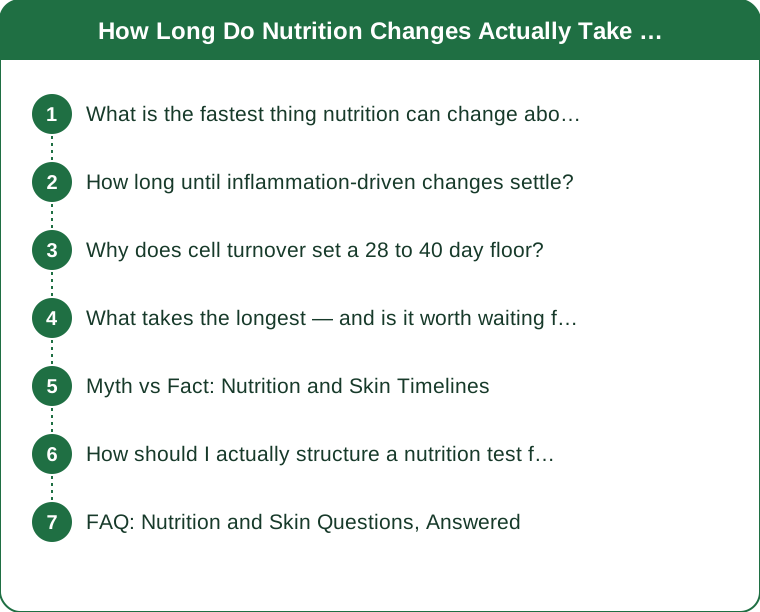
What is the fastest thing nutrition can change about skin?
Water balance, and it moves within days.
Skin holds a substantial portion of the body’s water, and the outermost layer’s water content responds to hydration status within 24 to 72 hours. This is why a weekend of poor sleep, alcohol, and salty food shows on Monday morning, and why three days of decent water intake genuinely does change how skin looks.
Sodium is the fast lever most people ignore. A high-sodium day shifts fluid into tissues, which is why faces look puffy after takeout and settle by day two. This isn’t inflammation and it isn’t damage — it’s fluid, and it resolves on its own.
Alcohol works on the same timeline in the opposite direction. It suppresses antidiuretic hormone, increasing fluid loss, and the visible effect on skin dryness and dullness typically peaks 12 to 36 hours after drinking.
What this means practically: if you’re evaluating a nutrition change, don’t judge it on a day when the previous 48 hours were unusual. Compare like to like — a normal Wednesday to a normal Wednesday, four weeks apart.
The trap here is mistaking fast for meaningful. Water-driven changes are real, but they’re also completely reversible with one bad weekend. They aren’t the changes worth reorganizing your diet for.
How long until inflammation-driven changes settle?
Roughly 1 to 3 weeks, depending on what’s driving it.
Inflammatory redness, reactivity, and some forms of breakout respond to dietary change faster than structural properties do, because you’re changing the signaling environment rather than rebuilding tissue.
The most-studied dietary link here is high-glycemic eating. Blood sugar spikes raise insulin and IGF-1, which increase sebum production and skin cell proliferation. Studies on low-glycemic diets have generally shown measurable changes in acne over 8 to 12 weeks, though people often notice something shifting well before the study endpoints.
Dairy shows up in the research for some people and not others, which matches what people report anecdotally. If you’re testing it, give it a full 6 weeks — shorter trials get confounded by the normal week-to-week variation skin has anyway.
Omega-3 intake changes membrane composition over about 4 to 8 weeks. Red blood cell fatty acid profiles shift on roughly that schedule, and skin follows a similar course.
The confounder nobody controls for is stress. Cortisol drives inflammatory skin changes powerfully, and a stressful month can completely mask a good dietary change. If your test period included something genuinely difficult, the test is inconclusive rather than negative.
Practical approach: change one thing, hold it 6 weeks, photograph in the same light weekly. Memory is unreliable for gradual change in a way that photographs aren’t.
Why does cell turnover set a 28 to 40 day floor?
Because a skin cell born today doesn’t reach the surface for about a month, and nothing you eat changes that fundamental schedule.
Keratinocytes form at the base of the epidermis, migrate upward, flatten, and shed. In a healthy young adult the full transit is roughly 28 days. By your forties it’s closer to 40 days, and past sixty it can stretch beyond 50.
This is the single most useful number in the entire conversation. Whatever nutritional environment you create today shapes cells that will appear on your surface in a month. The skin you’re looking at right now was built from the nutrition of four to six weeks ago.
It cuts both ways. A bad month shows up later than you expect, and a good month pays off later than you’d like. Both are why people abandon changes right before those changes were about to become visible.
What turnover-dependent changes look like: texture, smoothness, evenness of tone, how light reflects off the surface. These are the changes people mean when they say skin looks “healthy” — and they cannot appear faster than the turnover cycle allows.
Set your first real evaluation at 6 weeks. Not 2, not 4. Six weeks covers one full turnover cycle with margin, and it’s short enough that you’ll actually stick to it.

What takes the longest — and is it worth waiting for?
Collagen. It takes 8 to 12 weeks at absolute minimum, often considerably longer, and yes.
Collagen turnover in the dermis is slow — measured in months to years, not weeks. The dermal collagen network is the structural layer responsible for firmness and how skin recovers from being stretched or creased.
Vitamin C is genuinely required for collagen synthesis — it’s a cofactor for the enzymes that stabilize collagen’s structure, which is not a marketing claim but basic biochemistry. Adequate protein intake matters for the same reason: collagen is a protein, and you can’t build it from nothing.
Studies on oral collagen peptides have generally run 8 to 12 weeks before reporting changes in elasticity or hydration measures, which tells you something about the realistic timeline regardless of what you think of the supplement itself.
The much larger variable is sun exposure. UV degrades collagen far faster than nutrition builds it. Daily sunscreen does more for the collagen you already have than any dietary change does for the collagen you’re building — this is the least exciting and most consistently supported point in skin science.
Realistic expectation setting: at 12 weeks of genuinely consistent good nutrition, expect meaningful changes in texture and tone, modest changes in firmness, and no change at all in things that are structural or genetic.
Myth vs Fact: Nutrition and Skin Timelines
Myth: Drinking more water dramatically improves skin. Fact: If you’re dehydrated, correcting it helps within days — genuinely. If you’re already adequately hydrated, drinking more does very little, because the body regulates skin hydration and excess water is simply excreted. The dramatic before-and-afters usually involve someone who was substantially under-hydrated.
Myth: A detox or cleanse clears skin. Fact: Any visible change in three days is fluid balance plus the removal of alcohol and high-sodium food. There’s no mechanism by which a juice cleanse accelerates cell turnover, and the liver and kidneys don’t need help from a product.
Myth: Chocolate causes acne. Fact: The research is mixed and mostly implicates the sugar and dairy in most chocolate rather than cocoa itself. Dark chocolate with high cocoa content shows up very differently in the literature than milk chocolate.
Myth: If a change hasn’t shown in three weeks, it isn’t working. Fact: Three weeks is less than one turnover cycle. This single misconception ends more genuinely effective changes than any other.
Myth: Supplements work faster than food. Fact: They’re absorbed on the same schedule and act through the same pathways. A supplement can correct a deficiency efficiently, but it cannot outrun the timeline of the tissue it’s meant to affect.
Myth: Skin improvement is linear. Fact: It isn’t, and this is worth knowing. Most people see a fluctuating trend with clearly worse weeks inside a generally improving pattern. Hormonal cycling alone guarantees this.
How should I actually structure a nutrition test for skin?
Like an experiment, because a test you can’t interpret wastes twelve weeks.
Change one variable. If you simultaneously cut dairy, add omega-3, drink more water, and start sleeping better, you will learn nothing about which one mattered. The temptation to change everything at once is strong and it’s the main reason people can’t answer this question for themselves.
Photograph weekly under identical conditions. Same room, same time of day, same light source, no makeup, no filter. Natural indirect light from a window is the most repeatable setup most people have access to. Facing the window, not with it behind you.
Run it 12 weeks, evaluate at 6. The 6-week checkpoint tells you whether anything is moving. The 12-week endpoint is where structural changes become assessable.
Track the confounders even if you can’t control them: sleep, stress, menstrual cycle phase, sun exposure, and any product changes. A stressful month or a new skincare product will overwrite your dietary variable entirely, and you want to know when that happened.
Keep the rest of your routine frozen. New cleanser, new serum, new anything — not during a test. This is boring advice and it’s the difference between a real answer and another year of guessing.
Decide your success criteria in advance. “Better skin” is unmeasurable. “Fewer than four inflamed spots per week” or “less visible texture in weekly photos at 12 weeks” is something you can actually judge.
FAQ: Nutrition and Skin Questions, Answered
If I eat badly for one weekend, does it undo weeks of progress?
No. A single weekend produces mostly fluid and short-term inflammatory effects that resolve within a few days. Structural progress built over months isn’t erased by two days. The visible puffiness on Monday is real and also temporary.
Which single nutritional change has the best evidence for skin?
Lowering glycemic load has the most consistent support, particularly for acne. Adequate protein and adequate omega-3 intake come next. Notably, all three are also just general good nutrition — there’s no skin-specific magic separate from eating well.
Why did my skin get worse when I started eating better?
Several possibilities: normal fluctuation, a coincidental hormonal shift, a purge from an unrelated new skincare product, or a genuine reaction to something you added. Give it 6 weeks before concluding anything. If it’s clearly worsening and persistent, see a dermatologist.
Does age change these timelines?
Yes, meaningfully. Cell turnover slows from roughly 28 days in your twenties toward 40-plus days later, and collagen synthesis declines. Everything takes longer, which means the required patience increases rather than the potential disappearing.
This is general information, not medical advice. Persistent or severe skin concerns deserve evaluation by a dermatologist.
TL;DR: Four different clocks, and most people are watching the wrong one.
- 3 to 7 days: water balance and puffiness. Real, but completely reversible and not what you changed your diet for.
- 1 to 3 weeks: inflammatory reactivity begins shifting. Highly confounded by stress.
- 28 to 40 days: one full cell turnover cycle. This is the floor for texture and tone changes — nothing makes it faster.
- 8 to 12 weeks minimum: collagen-related firmness. Often longer, and sun protection matters more here than diet does.
- Test one variable, photograph weekly in identical light, evaluate at 6 weeks and 12.
The most common mistake isn’t picking the wrong food. It’s quitting at week three — one week before a full turnover cycle would have shown you the answer.
Keep Reading
This article is for general informational purposes only and is not medical advice. Always consult a qualified health professional for guidance specific to you.