The Complete Guide to Eating for Hair Growth: What the Research Actually Supports
Quick Answer: Hair growth nutrition support centers on adequate protein, iron, zinc, biotin (mainly relevant if you’re actually deficient), and omega-3s — but nutrition can only support hair that’s already growing normally; it can’t reverse genetic or hormonal hair loss patterns. Consistency over months matters more than any single ‘superfood.’
Hair growth supplements and superfood claims promise dramatic results, but the actual research paints a more modest, more useful picture: nutrition supports the hair growth cycle you already have, rather than acting as a dramatic accelerant. Here’s the complete, honest breakdown.

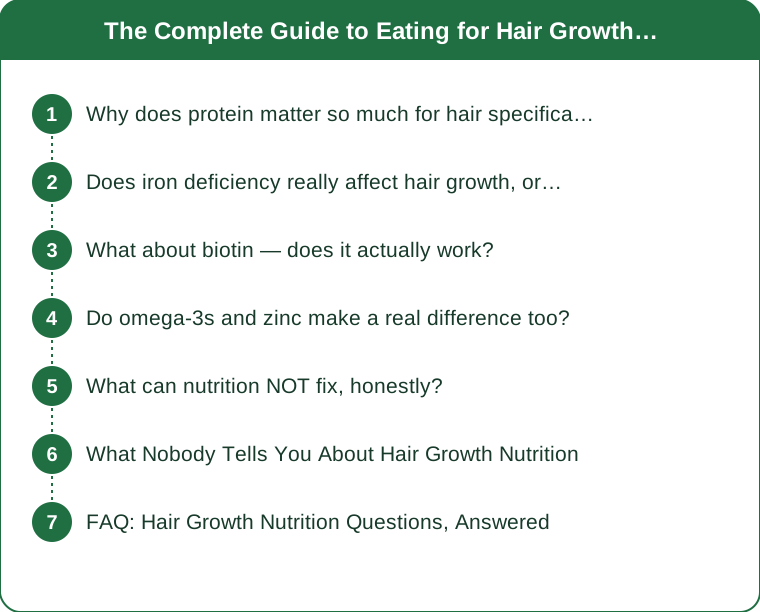
Why does protein matter so much for hair specifically?
Hair is made almost entirely of keratin, a protein structure, and hair follicles are among the more metabolically active tissues in the body — meaning they’re relatively sensitive to protein availability. Chronic low protein intake is one of the more well-established nutritional causes of hair thinning and slowed growth, independent of any other single nutrient.
Does iron deficiency really affect hair growth, or is that overstated?
It’s genuinely well-supported — iron deficiency is one of the most common nutritional causes of hair shedding, particularly in women, since iron is needed for oxygen delivery to rapidly dividing hair follicle cells. This is one of the few hair-nutrition connections with strong clinical research behind it, not just anecdotal claims.
What about biotin — does it actually work?
Biotin’s popularity outpaces its evidence for most people. It genuinely helps if you have an actual biotin deficiency, which is relatively uncommon in people eating a varied diet. For those without a deficiency, additional biotin supplementation shows limited measurable benefit in research — the marketing significantly outpaces what the studies actually show for non-deficient people.

Do omega-3s and zinc make a real difference too?
There’s reasonable evidence that omega-3s support scalp health and may reduce inflammation that can contribute to shedding, though the effect size in research is more modest than dramatic marketing claims suggest. Zinc supports the hair follicle’s protein synthesis and repair processes, and like iron, a genuine zinc deficiency is associated with thinning — though most people eating a varied diet with adequate protein already get sufficient zinc without needing to supplement specifically.
What can nutrition NOT fix, honestly?
Nutrition cannot reverse genetic pattern hair loss (androgenetic alopecia) or significant hormonal hair loss causes — these need medical evaluation and, often, medical treatment, not dietary changes alone. This is the most important honest caveat in this entire topic: good nutrition supports healthy hair growth you’re already capable of, but it isn’t a treatment for a hair loss condition with a different root cause.
What Nobody Tells You About Hair Growth Nutrition
Here’s what most hair-growth content skips: most people in developed countries eating a reasonably varied diet are not meaningfully nutrient-deficient for hair growth purposes, which means the dramatic before-and-after transformations attributed to a specific food or supplement in marketing are often driven by something else entirely — reduced stress, better sleep, hormonal changes, or simply natural cycle variation. Nutrition matters most as a genuine deficiency-correction tool, less as a universal accelerant for people already eating adequately.
FAQ: Hair Growth Nutrition Questions, Answered
How would I know if I actually have a nutrient deficiency affecting my hair?
A blood panel checking iron, ferritin, zinc, and vitamin D levels through your doctor is the only reliable way to know — guessing based on hair symptoms alone often leads to unnecessary supplementation.
How long does it take to see hair growth changes from nutrition improvements?
Hair grows slowly (roughly half an inch a month), and the growth cycle itself takes months, so nutritional changes typically need 3-6 months of consistency before any visible difference shows up.
Is there harm in taking hair growth supplements even without a diagnosed deficiency?
Generally low risk at reasonable doses, but it’s an unnecessary expense without real benefit if you’re not actually deficient — a blood panel is a more efficient use of money than trial-and-error supplementing.
TL;DR:
- Protein and iron have the strongest evidence behind them for hair growth support
- Biotin only meaningfully helps if you have an actual biotin deficiency, which is relatively uncommon
- Nutrition supports healthy growth you’re already capable of — it can’t reverse genetic or hormonal hair loss
- A blood panel, not guessing from symptoms, is the reliable way to know if you’re actually deficient in anything
Keep Reading
This article is for general informational purposes only and is not medical advice. Always consult a qualified health professional for guidance specific to you.